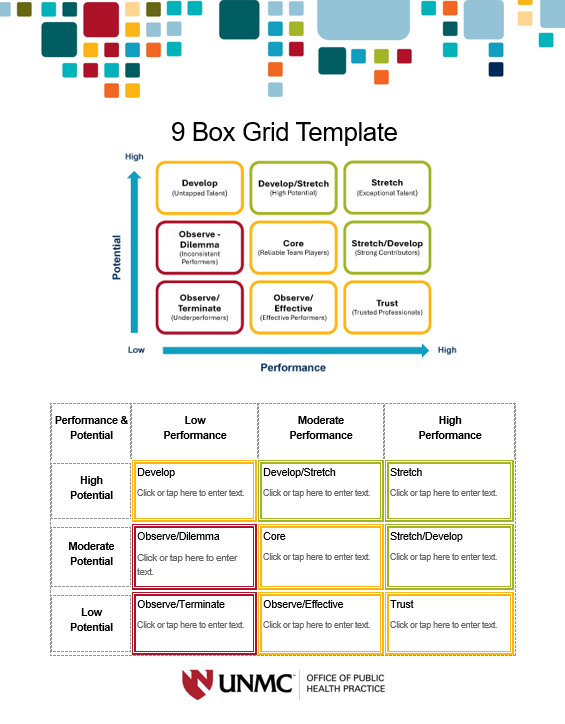
Talent Pool Review: Using the 9-Box Grid
Talent Pool Review: Using the 9-Box Grid
The Talent Pool Review uses the 9-Box Grid to evaluate employees based on their current performance and future potential. This is not a one-time conversation; this tool facilitates structured discussions that enable leaders to see the workforce more clearly, reduces bias, and creates shared understanding about talent within the organization.
Step A: Establishing Shared Agreements
Before placing anyone on the 9-Box Grid, leaders agree on:
-
Performance expectations (based on job responsibilities and evaluations)
-
Indicators of future potential (leadership practices in any role, learning agility, readiness)
-
Readiness timeframes (ready now, ready soon, future potential)
This ensures employees are evaluated against shared standards, not personal opinions.
Step B: Gather Evidence
Identifying the talent pool determines which employees will be included in the Talent Pool Review. Gathering evidence ensures employees are evaluated using consistent, role-aligned information.
Supervisors bring objective information for each employee in the talent pool, such as:
-
Demonstrated competencies
-
Completion of development activities
-
Observed leadership behaviors
-
Willingness and capacity to grow
This step reduces bias and keeps discussions fact-based. You are now ready to actively utilize the 9-Box Grid.
Step C: Placement on the 9-Box Grid
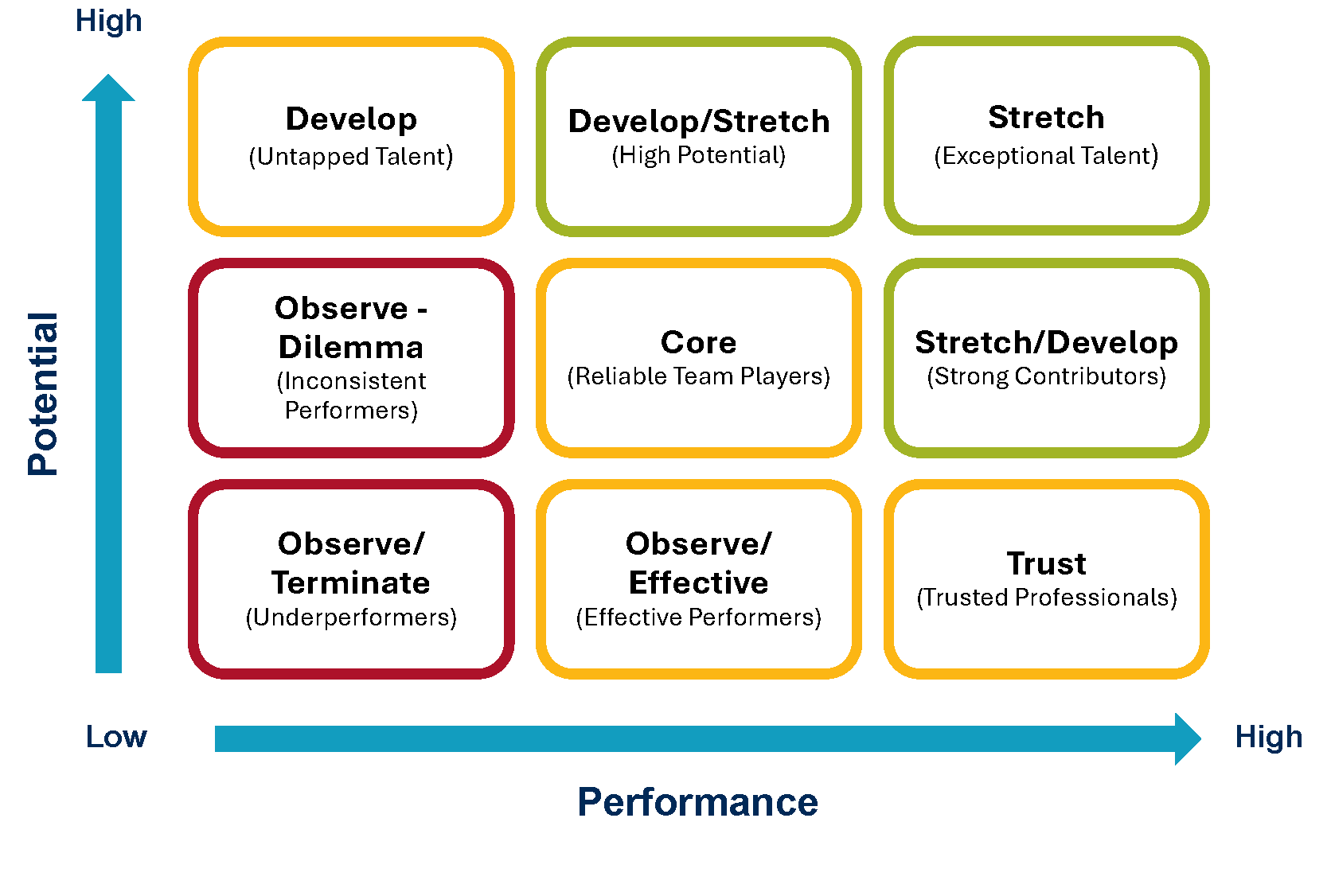
During the Talent Pool Review, employees are placed on the grid based on their performance plus potential. Placement reflects patterns over time, not single events. Multiple employees may fall into the same box on the Grid.
9-Box Grid Components
The Employee Potential Axis
On the vertical axis, employee potential is rated from low to high and defining it can be a little abstract. Additionally, it is helpful to keep in mind that there is a difference between an employee’s potential for growth and their readiness for promotion.
There are rarely clear-cut right or wrong answers when assessing employee potential or universal definitions for readiness timelines. The most important thing is that your organization establishes clear definitions and applies them consistently across all employees during the talent review process.
Below are example definition criteria for potential:
-
Low potential: the employee is performing effectively in their current role but is unlikely or uninterested in taking on broader or more complex responsibilities in the future. This may reflect career preferences, proximity to retirement, or a role that is already well aligned with their strengths
-
Moderate potential: the employee demonstrates the capacity and interest to expand their knowledge, skills, or responsibilities. With additional development, they could assume more complex work or leadership responsibilities over time
-
High potential: the employee consistently demonstrates the capacity, motivation, and learning agility to assume significantly broader responsibilities. They seek new challenges, adapt quickly, and show behaviors associated with future leadership or specialized roles
For this tool, potential reflects both an employee's capacity and interest in moving into a different role in the future. For example:
- You might rate someone as “low potential” to move because they have shared with you that they are close to retirement and are not interested in moving to a new role or it might be because they do not possess the needed skill set to move into a different job role.
The Employee Performance Axis
On the horizontal axis, employee performance is rated from underperforming to high performing.
This is based on the individual team members and their historical job performance. Some teams decide to apply a timeframe when considering performance to help guide them through rating performance. Two common options are to look at overall historical performance in the organization or to look at performance only over the last year. Again, not a right or wrong answer here, but if your team decides to use a timeframe, it is helpful to apply it consistently.
Below are example definition criteria for performance:
-
Low performance: the employee consistently falls short of meeting the expectations of their current role and requires significant support or performance improvement
-
Moderate performance: the employee meets many of the expectations of their role but demonstrates opportunities for continued growth or greater consistency
-
High performance: the employee consistently meets or exceeds the expectations of their role, achieves established goals, and demonstrates high-quality work
There is almost always more than one spot a team member can be placed on the 9-Box Grid. Part of the process is considering your organization as a whole and where others are being placed on the grid as well. Employees may reasonably fit into more than one box on the 9-Box Grid. The value of the Talent Pool Review comes from the discussion that allows leaders to consider evidence, compare perspectives, and reach a shared understanding. For example:
-
Someone who shows high potential but has not been with the organization long enough to demonstrate their consistency in performance might be considered “untapped talent” versus “high potential”.
-
Circling back to above, the team member who is a great performer and not interested in moving to a different position because they are about to go part time or retire soon would be “high performance + low potential” (the “Trust” box on the Grid)
Now the leadership team and Succession Planning Committee is ready to place employees on the 9-Box Grid based on the agreed-upon definitions of performance and potential:
-
Horizontal Axis: Performance
-
Vertical Axis: Potential
Because it is a subjective tool, the value comes from the perspectives of the committee and the discussion it generates. The 9-Box Grid is a tool meant to support meaningful discussions and help to create tangible succession planning pipelines. The 9-Box Grid intentionally separates performance (how well someone is doing today) from potential (their capacity and interest to grow). Readiness for a specific role is determined later in Step 4 by comparing an employee's performance and potential with the competencies and experience required for that position.