
Identify Vulnerable and Critical Positions
Identify Vulnerable and Critical Positions
When all job positions have been accounted for, you will begin to identify vulnerable and critical positions that could cause significant disruption to the organization if vacated quickly or for too long a time.
Vulnerable Positions
Vulnerable Positions are those with a high risk of vacancy due to factors such as upcoming retirements, difficulty in recruiting qualified candidates, or lack of identified successors.
You can use these questions to help determine position vulnerability:
- Do you expect an upcoming vacancy in the position due to retirements or planned departures within 1-3 years?
- Does the position have a history of high turnover or recruitment challenges?
- Are the required certifications or skills needed for the position difficult to find?
- How many qualified candidates are available internally? Externally?
- Could other staff take on these responsibilities temporarily? Do they have the capacity to do so?
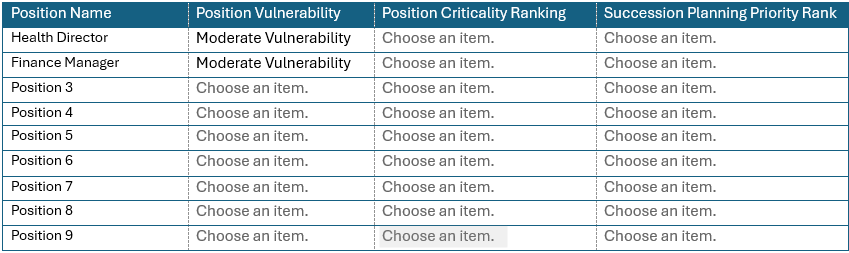
 High Vulnerability = No identifiable successor; difficult to replace; vacancy expected in 1-3 years
 Moderate Vulnerability = Potential internal successor(s) identified but need 1-2 years of development; recruitment would be moderately challenging
 Low Vulnerability = Successor ready now; recruitment is generally easy or position is part of a broader talent pool
Example of Position Vulnerability Identification
Critical Positions
Critical Positions are those roles that have a significant impact on the department’s ability to achieve its mission and deliver essential public health services. These often include leadership roles, technical experts, and specialized operational positions.
You can use these questions to help determine what positions are critical for your mission:
-
Does the position influence organizational stability and continuity?
-
Is the position mission-related or administrative in nature?
-
Does the position require unique skills or knowledge essential to public health operations?
-
Is the work related to your strategic goals?
-
Does the position impact mission-critical functions and service delivery?
-
Is the work legally mandated?
-
Will you need the position in the next 1-3 years?
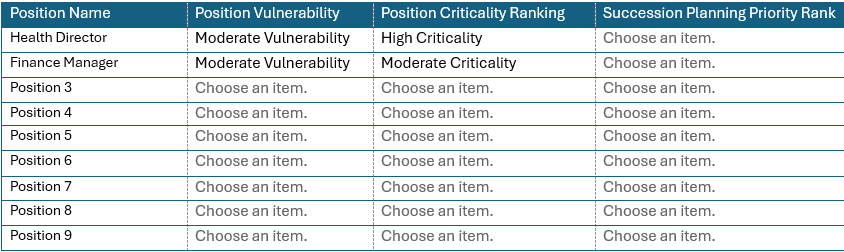
High Criticality = Essential to mission
Moderate Criticality = Moderate impact on mission
Low Criticality = Little influence on achieving the mission
Example of Position Vulnerability & Criticality Ranking
Plot a Risk Matrix to Prioritize Positions for Succession Planning
Using your vulnerability and criticality ranking, your committee is ready to determine which positions are the highest priority to begin succession planning. To do this, you use a Risk Matrix.
-
The Risk Matrix assigns each position a risk level based on vulnerability and criticality rankings you determined for each position.
-
For example, if a position in your spreadsheet is labeled “High Criticality” and “Low Vulnerability,” it would be labeled as “Moderate Risk.”
Here are guidelines to give meaning to the risk levels.
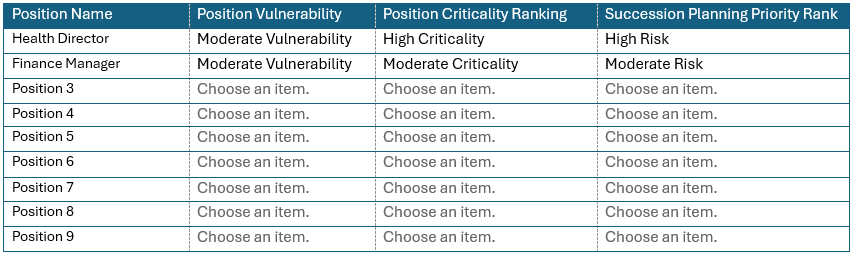
 High risk: Establish succession plan now
 Moderate Risk: Establish succession plan in the next 6-12 months
 Low Risk: Monitor Successor Progress
INSERT SCREENSHOT (COMING SOON): Risk Matrix for Determining Succession Planning Risk and Priority Rank
Below is an example of what your spreadsheet might start to look like as you work through this process.
Use the Risk Matrix Develop a Prioritization List of High Risk Positions
As part of the prioritization process, your committee will create a short list for succession planning with the positions most at risk and lacking either an identified successor or a successor who is farther away from being developed/ready. It is recommended to prioritize positions labeled “High Risk” first.
Below is an example of what your spreadsheet might start to look like as you work through this process.
COMING SOON INSERT SCREENSHOT
Your committee can also use this succession planning progress tracker to:
-
Track the progress of your succession plans and determine where development is most needed.
-
Begin by succession planning for the employees who may be able to temporarily fill their position while a permanent successor is identified.
-
Determine which positions do not have a successor ready now and identify developmental opportunities for potential successors